




Manlift vs. Scissor Lift: What's the Real Difference? (Plus AWP & MEWP Explained)

The terms manlift and scissor lift are sometimes used interchangeably when referring to equipment designed for working at height. However, they do not describe exactly the same thing.
Manlift is a broad commercial term commonly used for different types of equipment designed to raise personnel to elevated working positions. A scissor lift, on the other hand, is a specific type of elevating work platform.
In simple terms:
A scissor lift can be described as a type of manlift, but not every manlift is a scissor lift.
Articulating boom lifts, telescopic boom lifts, and vertical mast lifts may also fall within the broader group of equipment commonly described as manlifts.
In international technical terminology, MEWP (Mobile Elevating Work Platform) is widely used as the general term for this equipment category.
This guide explains the difference between manlifts and scissor lifts, the main types of access platforms, and the factors to consider when selecting the right machine for an application.
What Is a Manlift?
A manlift is a general commercial term used for equipment designed to lift personnel to elevated working positions.
It does not necessarily refer to one particular machine design. Different types of manlifts are available depending on the required working height, horizontal outreach, operating environment, and ground conditions.
Common types include:
Scissor Lifts
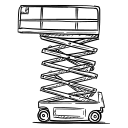
Scissor lifts use a crossed scissor mechanism to raise the platform primarily in a vertical direction. They are widely used for maintenance, installation, warehouse, factory, and construction applications.
Articulating Boom Lifts
Articulating boom lifts use multiple boom sections and joints to provide both vertical and horizontal access. They are particularly useful when workers need to reach over or around obstacles.
Telescopic Boom Lifts
Telescopic boom lifts provide extended horizontal and vertical reach and are commonly used where high or distant working points need to be accessed.
Vertical Mast Lifts
Vertical mast lifts provide compact personnel access and can be particularly useful in restricted indoor working areas.
Therefore, manlift should be understood as a broad commercial description rather than one specific machine configuration.
What Is a Scissor Lift?
A scissor lift is a type of mobile elevating work platform that uses a crossed scissor mechanism to raise the working platform vertically.
One of the main characteristics of a scissor lift is its relatively large platform area, which can provide working space for personnel, tools, and materials.
Scissor lifts are commonly used for:
- Factory maintenance and installation
- Warehouses and logistics facilities
- Construction projects
- Electrical and mechanical installation
- High-ceiling facilities
- Indoor and outdoor maintenance
Different scissor lift models can be selected according to required working height, machine width, platform capacity, and ground conditions.
Explore Galen Equipment Scissor Lifts →
Manlift vs. Scissor Lift
Feature | Manlift | Scissor Lift |
|---|---|---|
Meaning | Broad commercial description | Specific type of access platform |
Scope | Can describe several types of personnel lifts | Refers specifically to machines using a scissor mechanism |
Movement | Depends on machine type | Primarily vertical |
Examples | Scissor, articulating boom, telescopic boom, vertical mast | Electric, rough-terrain or tracked scissor lifts |
Typical applications | Depends on equipment type | Maintenance, installation, warehouses, factories, construction |
Technical definition | General commercial terminology | Specific equipment type |
The main difference is therefore scope.
Manlift is the broader concept, while a scissor lift is a specific type of manlift.
For example, someone looking for a “15 m manlift” may ultimately need a rough-terrain scissor lift, articulating boom lift, or telescopic boom lift depending on the application.
For this reason, equipment selection should consider more than working height alone. Horizontal outreach, ground conditions, available working space, and platform capacity are also important.
What Are the Main Types of Manlifts?
Choosing the appropriate type of manlift starts with understanding the working environment and access requirement.
Scissor Lifts
Designed primarily for vertical access and applications requiring a relatively large working platform. Electric scissor lifts can be particularly suitable for factories, warehouses, and other indoor applications.
Rough-Terrain Scissor Lifts
Designed for outdoor applications, uneven surfaces, and more demanding ground conditions.
Explore Rough-Terrain Scissor Lifts →
Articulating Boom Lifts
Articulating boom structures allow the platform to reach over and around obstacles, making them suitable for applications where direct vertical access is not possible.
Explore Articulating Boom Lifts →
Telescopic Boom Lifts
Designed for applications requiring significant horizontal outreach as well as high working heights.
Explore Telescopic Boom Lifts →
Vertical Mast Lifts
Compact access equipment designed for personnel lifting in restricted working environments.
What Should You Consider When Choosing a Manlift?
Choosing the right manlift should not be based only on maximum working height.
Several factors should be evaluated.
Working height: Determine the highest working point that personnel need to reach.
Horizontal outreach: Consider whether the work can be reached vertically or whether personnel need to reach over or around an obstacle.
Ground conditions: A smooth factory floor and an uneven construction site can require very different machines.
Machine width: Doorways, aisles, and restricted access points should be considered.
Platform capacity: Consider the combined weight of personnel, tools, and materials required on the platform.
Indoor or outdoor operation: Depending on the environment, electric, tracked, or rough-terrain equipment may be more appropriate.
Once these requirements are established, the appropriate platform type and model can be selected.
Manlift, AWP and MEWP: What Is the Difference?
Several terms are used internationally for equipment designed to provide elevated personnel access.
Manlift
Manlift is a commonly used commercial term for equipment designed to raise personnel to elevated working positions.
It can describe different machine types rather than one specific design.
AWP – Aerial Work Platform
Aerial Work Platform (AWP) is another widely recognized industry term for equipment used to provide temporary access to elevated working positions.
MEWP – Mobile Elevating Work Platform
MEWP stands for Mobile Elevating Work Platform and is widely used in current international technical and safety terminology.
Standards such as EN 280 address the design and safety requirements applicable to mobile elevating work platforms.
A simple way of understanding the terminology is:
Manlift → common commercial terminology
AWP → widely recognized industry terminology
MEWP → current international technical terminology
For technical specifications, quotations, and project requirements, however, identifying the specific equipment type—such as scissor lift, articulating boom lift, or telescopic boom lift—is more precise than relying only on an umbrella term.
Why Is Choosing the Correct Platform Type Important?
The term “manlift” may describe a general requirement for working at height, but the correct machine depends on the application.
For example:
Smooth factory floor + vertical access
→ An electric scissor lift may be appropriate.
Restricted indoor area + compact access requirement
→ A vertical mast lift may be considered.
Access over an obstacle
→ An articulating boom lift may be more appropriate.
Long horizontal outreach
→ A telescopic boom lift may be considered.
Uneven outdoor terrain
→ A rough-terrain or tracked platform may be required.
The objective should therefore not simply be to find a “manlift,” but to identify the correct type of access platform for the application.
Is a manlift the same as a scissor lift?
No. Manlift is a broader term. A scissor lift is one type of personnel lifting equipment that may be described as a manlift. Articulating boom lifts, telescopic boom lifts, and vertical mast lifts may also fall within the broader manlift category.
Is every manlift a scissor lift?
No. A scissor lift is one type of manlift, but different applications may require an articulating boom lift, telescopic boom lift, vertical mast lift, or another type of access platform.
What determines manlift prices?
Manlift prices can vary according to equipment type, working height, horizontal outreach, platform capacity, drive system, battery technology, machine configuration, and optional equipment. The appropriate platform type should therefore be identified before comparing prices.
What should I consider when choosing a manlift?
Working height, horizontal outreach, ground conditions, machine dimensions, platform capacity, and operating environment are among the main selection criteria.
What is the difference between AWP and MEWP?
AWP stands for Aerial Work Platform, while MEWP stands for Mobile Elevating Work Platform. Both terms are associated with equipment used to provide elevated personnel access, although MEWP is widely used in current international technical terminology.
What are scissor lifts used for?
Scissor lifts are commonly used for factory maintenance, warehouses and logistics facilities, electrical and mechanical installation, construction, facility maintenance, and other applications requiring primarily vertical access.
Is it better to rent or buy a manlift?
The answer depends on utilization and operating requirements. Renting may be appropriate for short-term or project-based work, while purchasing can become more economical for regular and intensive use. Financing, maintenance, service costs, rental rates, and residual value should be evaluated together.
Conclusion: Manlift Is a Broad Term, Scissor Lift Is a Specific Platform Type
Manlift and scissor lift should not be treated as exact synonyms.
A manlift is a broad commercial term that can refer to different types of equipment designed to raise personnel.
A scissor lift is a specific platform type that uses a scissor mechanism to provide primarily vertical access.
Depending on the application, the appropriate solution may be a:
scissor lift, rough-terrain scissor lift, articulating boom lift, telescopic boom lift, or vertical mast lift.
Galen Equipment provides access equipment for different working heights, environments, and applications.
You can explore our scissor lift range, compare other access platform categories, or contact Galen Equipment with your required working height and application to identify a suitable machine.